


 Guide updated by Veedushi Bissessur on 20 November 2026
Fortaleza is the capital of the state of Ceará and the largest city in Brazil's Northeast. With 2,582,360 residents in 2026 (IBGE), it is now the fourth most populous city in Brazil, just ahead of Salvador. For expats, it offers big-city services, a long urban coastline and living costs well below those of São Paulo or Rio de Janeiro.
A coastal city on the rise
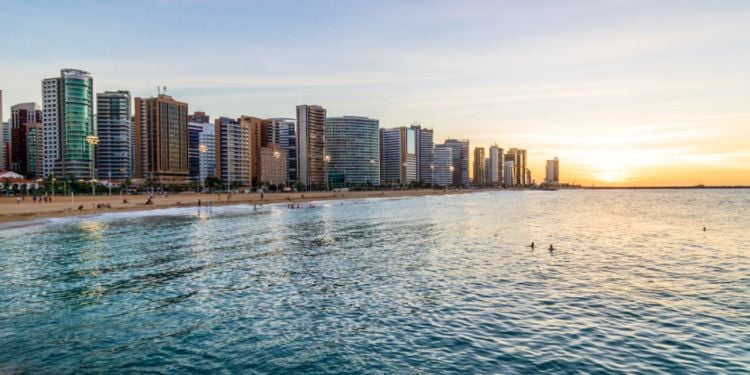
The city stretches along about 34 km of Atlantic shoreline, from the high-rise seafront of Meireles to the beach bars of Praia do Futuro. It is warm and breezy all year, with most rain falling between February and May. The official language is Portuguese and the currency is the Brazilian real (BRL, R$). In November 2026, USD 1 bought about R$5.44.
Fortaleza is also changing fast. It is one of the most connected places in the Americas, with 16 submarine internet cables landing in Ceará and another under way. This has drawn billions in data centre and green energy projects to the nearby Pecém port complex. The latest census counted only a few thousand foreign residents in Ceará, led by Venezuelans, Americans and Portuguese, so you will live mostly among locals and pick up Portuguese quickly.
Getting there is simple. Pinto Martins International Airport sits inside the city, about 20 minutes from the seafront, and the new light rail branch now links it to the metro network. Fortaleza is also one of the closest Brazilian cities to Europe and North America, which keeps flight times home shorter than from the south of the country.
5 good reasons to move to Fortaleza
- Low cost of living: Numbeo ranks Fortaleza among Brazil's cheapest large cities, with a cost of living index of 31.1 and a rent index of just 6.5.
- Year-round beach weather: warm sea, steady trade winds and an easy outdoor lifestyle.
- A growing tech and energy hub: submarine cables, new data centres and green hydrogen projects are creating skilled jobs.
- The Northeast's biggest market: more than 2.5 million people and a full range of hospitals, malls and universities.
- A gateway to famous coastlines: Jericoacoara, Canoa Quebrada and the kitesurf spot of Cumbuco are all within reach.
Sources: Agência Brasil / IBGE population estimates 2026, Numbeo – Brazil city rankings
Your setup journey
Guide in 9 steps. Click any step below to jump directly to the section you need.
01Working in Fortaleza: Jobs, Key Industries and Work Permits
Fortaleza's job market is driven by services, trade, tourism and a fast-growing digital and energy sector. Unemployment is higher than the national average, and most jobs require good Portuguese. Skilled profiles in IT, engineering and renewables have the best prospects, while many foreigners work remotely for employers abroad.
The job market in figures
The table below sums up the main labour market indicators. City-level wage data is not published for 2026, so the average income shown is the regional figure for Brazil's Northeast.
Unemployment rate, Fortaleza (Q2 2026) | 7.2% (Brazil: 5.2% in Q3 2026) |
Average monthly work income (Northeast region, Q1 2026) | R$2,616 (USD ~481) |
National minimum wage (2026) | R$1,621 per month (USD ~298) |
Leading sectors | Services and trade, tourism, data centres and IT, renewable energy, port logistics |
Sources: IBGE PNAD Contínua Q2 2026 (via Folha PE), IBGE PNAD Contínua Q3 2026, IBGE – PNAD Contínua Q1 2026, Presidency of Brazil – Decree 12,797/2025
Key industries to watch
Ceará is becoming one of Brazil's digital gateways. In 2026, the federal government approved five data centres in the Pecém Export Processing Zone, including a ByteDance (TikTok) project, with around R$571 billion (USD ~105 billion) in announced investment. A study by FGV estimates that a single data centre can create 12,500 construction jobs and 1,860 permanent roles. The Pecém complex also hosts a green hydrogen hub with seven pre-contracts signed by companies such as EDF, Fortescue and Voltalia, and its total project pipeline reached R$391.4 billion in October 2026. Ceará also produces more than half of Brazil's solar power.
Tourism, hospitality and retail remain the largest employers in the city itself. Starting a business is fast: in July 2026, it took an average of 19 hours to register a company in Ceará through the JUCEC trade board, and more than 100,000 firms opened between January and July.
Work permits and remote work
To work for a Brazilian employer, you need a residence permit for work, usually requested by the company before you arrive. Remote workers paid from abroad can apply for the digital nomad visa (VITEM XIV), which requires an income of at least USD 1,500 per month or savings of USD 18,000. This visa does not allow you to work for Brazilian clients. All residents must register with the Federal Police within 90 days of arrival to obtain the national migration card (CRNM).
Sources: O POVO – data centres, Oct 2026, O POVO – Pecém investments, Oct 2026, JUCEC business registrations 2026 (via O POVO), CNIg Normative Resolution 45/2021, gov.br – Register as a foreigner in Brazil
Discover more
02Housing & Neighbourhoods: Where to Live in Fortaleza
Housing in Fortaleza is still affordable by international standards, but prices are rising fast. In March 2026, the city recorded the highest annual increase in property prices among Brazilian state capitals on the FipeZAP index. Most expats rent an apartment in a secure building close to the seafront or the business district.
Types of housing
The most common choice is an apartment in a condomínio, a residential building with 24-hour security, a pool and shared facilities. Houses in gated communities are more common in the southern suburbs of Eusébio and Aquiraz. On top of rent, tenants usually pay the building fee (condomínio) and often the property tax (IPTU), so check what is included. The average purchase price was R$9,254 per m² (USD ~1,701) in March 2026, below the national average of R$9,720.
Popular neighbourhoods
The table below shows the most sought-after areas and their average sale price per square metre, a good indicator of how expensive rents will be.
Neighbourhood | Price per m² (June 2026) | Why expats choose it |
Meireles | R$12,965 (USD ~2,383) | Seafront on Avenida Beira-Mar, the most searched area for rentals |
Aldeota | R$11,673 (USD ~2,146) | Business and shopping district next to Meireles |
Engenheiro Luciano Cavalcante | R$10,459 (USD ~1,923) | Residential, close to malls and Unifor |
Centro | R$9,793 (USD ~1,800) | Historic centre with fast-rising prices |
Sources: FipeZAP index, June 2026 (via Diário do Nordeste), FipeZAP index, March 2026
Mucuripe and Cocó are also popular with professionals, while Praia de Iracema attracts those who want nightlife nearby.
Average rents
Numbeo's most recent city data (August 2025) gives the following monthly rents. Users report that good apartments in prime areas cost more than these averages.
One-bedroom apartment, city centre | R$1,883 (USD ~346) |
One-bedroom apartment, outside centre | R$1,140 (USD ~210) |
Three-bedroom apartment, city centre | R$2,240 (USD ~412) |
Three-bedroom apartment, outside centre | R$1,900 (USD ~349) |
Sources: Numbeo – Cost of Living in Fortaleza
How renting works
Leases are governed by the Tenancy Law (Lei do Inquilinato) and usually last 30 months. Landlords ask for one guarantee: a local guarantor (fiador), rent guarantee insurance (seguro-fiança) or a deposit (caução) of up to three months' rent. You will need a CPF and usually proof of income.
Sources: Tenancy Law 8,245/1991
Join the discussion on the forum
03Cost of Living in Fortaleza: Monthly Budgets for Singles and Families
Fortaleza is one of the most affordable large cities in Brazil. In November 2026, Numbeo gave it a cost of living index of 31.1 and a rent index of 6.5, far below major cities like London or Sydney. The figures below come from Numbeo's latest Fortaleza data (August 2025); inflation and the weaker real since late 2026 may shift some amounts.
Budget for a single person
This table shows typical monthly costs for one person living in a central one-bedroom apartment. Numbeo estimates total monthly spending of about R$3,182 (USD ~585) excluding rent, which covers food, transport and leisure.
Expense | BRL | USD (approx.) |
Rent, 1-bedroom, city centre | R$1,883 | USD 346 |
Monthly costs excluding rent (food, transport, leisure) | R$3,182 | USD 585 |
Utilities, 85 m² (electricity, water, air conditioning) | R$543 | USD 100 |
Internet (60 Mbps or more) | R$101 | USD 19 |
Mobile plan (10 GB+) | R$70 | USD 13 |
Monthly public transport pass | R$170 | USD 31 |
Gym membership | R$129 | USD 24 |
Meal at an inexpensive restaurant | R$30 | USD 5.50 |
Sources: Numbeo – Cost of Living in Fortaleza, Numbeo – Brazil city rankings
Budget for a family of four
For a family, Numbeo estimates around R$11,142 per month (USD ~2,048) excluding rent. The table adds the main housing and childcare costs.
Expense | BRL | USD (approx.) |
Rent, 3-bedroom, city centre | R$2,240 | USD 412 |
Rent, 3-bedroom, outside centre | R$1,900 | USD 349 |
Monthly costs excluding rent | R$11,142 | USD 2,048 |
Utilities, 85 m² | R$543 | USD 100 |
International primary school (per year, per child) | R$12,000 | USD 2,206 |
Private full-day pre-school (per month, per child) | R$1,169 | USD 215 |
Sources: Numbeo – Cost of Living in Fortaleza
Health insurance
Private health plan prices depend on age and coverage, and no official average is published for Fortaleza. Annual increases on individual and family plans are capped by the regulator: the ANS set a maximum rise of 5.11% for May 2026 to April 2027, the lowest cap since 2000 outside the pandemic year. Ask for quotes from several insurers before you arrive, and check whether your international policy is valid in Brazil.
Electricity is often the biggest surprise in the budget, as air conditioning runs for much of the year. Choosing a well-ventilated apartment close to the sea breeze can cut utility bills noticeably.
Sources: ANS – 2026 health plan adjustment
04Retirement in Fortaleza: Visa, Healthcare and Budget
With warm weather, a long seafront and low living costs, Fortaleza is a realistic option for retirees with a foreign pension. Brazil offers a dedicated residence route for retirees, and good private hospitals are available in the city. The main challenges are the language and the paperwork, so plan ahead.
The retirement visa
Brazil's temporary visa for retirees (VITEM XIV) is granted to foreigners who can prove a stable monthly income from abroad of at least USD 2,000, plus USD 1,000 for each dependant. Income can come from a pension, a survivor's pension, rental income or investments. There is no minimum age and no language test. You apply at a Brazilian consulate in your country of residence, then register with the Federal Police within 90 days of arrival.
Pensions and social security
If you have worked in the United States, the US–Brazil social security agreement lets you combine contribution periods from both countries to qualify for benefits. Claims are handled by the INSS agreements office in Belo Horizonte. Brazil has no tax treaty in force with the US or the UK, so check how your pension will be taxed before you move.
Sources: Consulate General of Brazil in New York – Retirement visa, INSS – International agreements (Ordinance 1,275/2021)
Healthcare and living costs
Retirees who are legal residents can use the free public SUS, but most choose a private health plan for shorter waiting times. Premiums rise with age, and annual increases on individual plans are capped by the ANS (5.11% for 2026–2027). Numbeo estimates that a single person spends about R$3,182 per month (USD ~585) excluding rent, so a USD 2,000 pension covers a comfortable lifestyle, including a central one-bedroom apartment at about R$1,883 (USD ~346).
Choose a flat near the seafront in Meireles or Aldeota, where pharmacies, clinics and supermarkets are within walking distance. The flat promenade of Avenida Beira-Mar is ideal for morning walks, and many residents join outdoor exercise groups along the seafront. Keep in mind that after 183 days in Brazil you become a tax resident, so your worldwide income must then be declared to the Receita Federal.
Sources: ANS – 2026 health plan adjustment, Numbeo – Cost of Living in Fortaleza
05Higher Education & Universities in Fortaleza
Fortaleza is a major university city with free public universities and well-equipped private ones. Teaching is almost entirely in Portuguese, so most international students take a language course first. Exchange students and degree-seeking foreigners each follow a different path.
Main universities
The Federal University of Ceará (UFC), founded in 1954, is the city's leading public university and one of the most international in Brazil. Like all federal universities, it charges no tuition fees. Its international office, PROINTER, runs exchange programmes and supports foreign students, and it was still publishing calls for international students in 2026. The academic year has two semesters: February–June and August–December.
The University of Fortaleza (Unifor) is the main private university, run by the Edson Queiroz Foundation. It charges monthly fees and offered discounts of up to 40% to new students for the second semester of 2026. The State University of Ceará (UECE) and the Federal Institute of Ceará (IFCE) are other free public options, with IFCE focused on technical and technology degrees.
How to apply as a foreigner
There are three main routes:
- Exchange semester: apply through your home university's partnership with UFC. Deadlines are 30 April for an August start and 30 October for a February start. Proof of health and accident insurance is required.
- Full degree: public universities admit students through the national entrance exam (ENEM) and the SISU system, similar in purpose to A-levels or SAT-based admissions.
- Government scholarships: the PEC-G (undergraduate) and PEC-PG (postgraduate) programmes are reserved for citizens of partner developing countries.
You will need a student visa (VITEM IV) and must register with the Federal Police on arrival. To use a foreign degree professionally in Brazil, it must be validated (revalidação) by a Brazilian public university, a process managed through the Ministry of Education's Carolina Bori platform.
Sources: Federal University of Ceará (UFC), UFC international office fact sheet, UFC PROINTER Notice 18/2026, University of Fortaleza (Unifor), State University of Ceará (UECE), Federal Institute of Ceará (IFCE)
06Schooling for Children: International and Bilingual Schools in Fortaleza
Families moving to Fortaleza can choose between free public schools, Brazilian private schools and a small number of international and bilingual schools. Most expat families choose private education, mainly because teaching in public schools is only in Portuguese and quality varies. Places at the best schools fill up, so contact them early.
How the local system works
School is compulsory from age 4 to 17. Children go through educação infantil (pre-school), nine years of ensino fundamental (primary and lower secondary) and three years of ensino médio (upper secondary), which leads to a certificate equivalent to a high school diploma. All schools follow the national curriculum (BNCC). Public schools are free and must accept foreign children. The school year runs from February to December, so children arriving mid-year from the Northern Hemisphere may need to adjust grades.
International and bilingual options
The table below lists the main schools teaching in English or offering an international track. Fee data is scarce and schools publish their fees privately, so ask each school for its current price list.
School | Curriculum | Key facts |
Escola Americana de Fortaleza (EAF) | American, taught in English | Pre-school to Grade 12; accredited by Cognia (formerly AdvancED) |
Maple Bear Fortaleza | Canadian bilingual method | English immersion from early years to high school |
Colégio 7 de Setembro | Brazilian + optional international class | 91-year-old school with an international track recognised in Brazil |
Colégio Ari de Sá Cavalcante | Brazilian with international methods | Several campuses; strong university entrance results |
Sources: Escola Americana de Fortaleza, Numbeo – Cost of Living in Fortaleza
As a rough benchmark, Numbeo reported tuition of about R$12,000 per year (USD ~2,206) for an international primary school in 2025, based on very few entries. Families looking for the International Baccalaureate should check the IB World School directory, as only one IB school is listed in the city.
Enrolling your child
Schools usually ask for the child's passport, CRNM or visa, CPF tax number, previous school reports and vaccination records. Foreign documents may need an apostille and a sworn translation into Portuguese. A full-time private pre-school costs about R$1,169 per month (USD ~215), according to Numbeo.
Sources: IB – Find an IB World School, Numbeo – Cost of Living in Fortaleza
07Daily Life in Fortaleza: Getting Around and Settling In
Daily life in Fortaleza moves at a relaxed, coastal pace. Mornings start early to avoid the heat, the seafront fills up at sunset, and much of social life takes place outdoors. A few practical habits will make your first months easier.
Getting around
City buses are run by Etufor. Since 1 January 2026, a full fare costs R$5.40 (USD ~0.99), up 20% from R$4.50. The student fare stays at R$1.50, and an off-peak Hora Social fare of R$3.90 applies at set times. The prepaid Bilhete Único card allows unlimited transfers within two hours.
Rail services are run by Metrofor. The metro's South Line to Maracanaú costs R$3.60, and a new light rail (VLT) branch linking the airport to Expedicionários station opened in February 2026. Bus and rail tickets are not yet integrated. Many residents also use ride-hailing apps and taxis, which start at about R$6 plus R$4 per km (Numbeo, 2025). Petrol costs about R$6.05 per litre (USD ~1.11).
Sources: Etufor 2026 bus fares (via Diário do Nordeste), Metrofor fares 2026, Numbeo – Cost of Living in Fortaleza
Shopping and food
Supermarkets, large malls and open-air markets make daily shopping easy. Basic prices are low: a litre of milk costs about R$5.89, a dozen eggs R$8.75 and a kilo of chicken fillets R$18.67 (Numbeo, 2025). Local cuisine is built around fresh fish, prawns, crab and tropical fruit.
Payments are increasingly digital. Most shops, taxis and even beach vendors accept PIX, Brazil's free instant transfer system, which you can use once you have a local bank account and CPF. Cards are widely accepted, but keep some cash for small market stalls.
Healthcare and practical tips
Brazil's public health system, the SUS, is free and open to all residents, including foreigners, much like the NHS or Medicare. Waiting times can be long, so most expats also buy a private health plan, regulated by the ANS. Little English is spoken outside hotels and international firms, so learning basic Portuguese is essential. As in any large Brazilian city, stay alert in quiet areas at night and avoid showing valuables.
Sources: Migration Law 13,445/2017, ANS – 2026 health plan adjustment
08Leisure, Culture & Things To Do in Fortaleza
Fortaleza's free time revolves around the sea, music and food. Weekends often mean a beach day, a seafood lunch and an evening of live forró. The city also has a good cultural centre, large parks and some of Brazil's best kitesurfing within an hour's drive.
Culture and the arts
The Centro Dragão do Mar de Arte e Cultura in Praia de Iracema is the city's main cultural hub, with museums, a cinema, a planetarium and outdoor concerts. The ornate Theatro José de Alencar in the centre hosts plays and music, while the Metropolitan Cathedral and the Passeio Público square are landmarks of the old town. For local crafts such as lace, hammocks and cashew products, head to the Mercado Central.
Beaches, sport and the outdoors
The seafront Avenida Beira-Mar is the place to run, cycle, play beach volleyball or browse the evening craft fair. Praia do Futuro is lined with large beach clubs (barracas), and Parque do Cocó offers trails through one of Brazil's largest urban parks. Thanks to strong, steady winds, Cumbuco and Taíba are world-class kitesurf spots, especially in the second half of the year. Football fans can watch Ceará Sporting Club or Fortaleza Esporte Clube at the Arena Castelão. A gym membership costs about R$129 per month (USD ~24, Numbeo 2025).
Nightlife and day trips
Praia de Iracema and the streets around Dragão do Mar are the centre of nightlife, with bars and forró nights through the week. In July, the Fortal street carnival draws large crowds. For weekends away, the dunes and lagoons of Jericoacoara, the red cliffs of Canoa Quebrada and the coloured sands of Morro Branco are easy to reach. Families also enjoy Beach Park in Aquiraz, one of the largest water parks in Latin America.
A cinema ticket costs about R$35 (USD ~6) and dinner for two in a mid-range restaurant about R$200 (USD ~37), so going out remains affordable.
Sources: Numbeo – Cost of Living in Fortaleza
09In short
Fortaleza combines the services of Brazil's fourth-largest city with a relaxed beach lifestyle and some of the lowest living costs among the country's major capitals. A one-bedroom apartment in the centre still costs under USD 350 a month, the sea is warm all year, and new data centres and energy projects are bringing fresh career opportunities. Learning Portuguese, sorting your visa and CPF early, and choosing the right neighbourhood will help you settle in quickly. Whether you come to work, study, raise a family or retire, the city has a lot to offer. Join the Expat.com Fortaleza forum to ask questions, share tips and connect with other expats already living there.
Join the Fortaleza community
Get regular tips and advice to make the most of your expat life
Essential services for your expat journey




Forum topics on living in Fortaleza
Discover forums topics on expat life in Fortaleza: join the conversation, ask your questions, get advice and share your experience.